So, since the last discussion of this back in June, the number of primary care doctors in our community who are available to see patients in the ER and in the hospital is no longer 7. It's down to 2. That's right, two.
I will continue in my arrangement with the hospital doctors to be available most, but not all of the time. It is simply not possible for me to be on call 24/7/365.
If you call the office after hours, you can leave a message. Naturally, if you feel you may be having a medical emergency, you should call 911. Otherwise, we will continue to return any phone messages early on the next business day.
Sunday, September 13, 2009


Child Abduction: How Likely?
Sorry, but I think I'm suffering Garrido overload.
As a dad, I wonder how likely it is that my daughter could be kidnapped by a complete stranger . I certainly remember my own childhood in which we all walked to and from school, got together afterwards to play ball, or went hunting for snakes and crayfish in the woods. I'm sad to see that few kids are allowed to have this sort of independence anymore, and wonder how dangerous coming home from school by yourself really is.
Well...
As a dad, I wonder how likely it is that my daughter could be kidnapped by a complete stranger . I certainly remember my own childhood in which we all walked to and from school, got together afterwards to play ball, or went hunting for snakes and crayfish in the woods. I'm sad to see that few kids are allowed to have this sort of independence anymore, and wonder how dangerous coming home from school by yourself really is.
Well...
115
number of children in the U.S. kidnapped in a single year
71,900,000
number of children in the U.S. in that same year
number of children in the U.S. kidnapped in a single year
71,900,000
number of children in the U.S. in that same year
The year in question is 1999, the most recent nationwide statistic I could find on the number of U.S. children who were abducted by strangers (not family members) with intent to keep, harm or hold them for ransom. I'm not sure where the 40 million U.S. children figure comes from in that same source link. The 40 million link goes to a demographic display on Nation Master. The link I have provided is much more specific and accurate.
Note that this figure includes all children under 18 years of age, not just 6-17 year olds.
So, doing the math...
Note that this figure includes all children under 18 years of age, not just 6-17 year olds.
So, doing the math...
1 in 625,217
Odds of a child in the U.S. being abducted by a stranger
0.00016%
Probability of the same
Odds of a child in the U.S. being abducted by a stranger
0.00016%
Probability of the same
For sake of comparison,
1 in 84
Odds of dying in a car accident
1 in 5,051
Odds of dying in a plane crash
1 in 340,733
Odds of being killed in a fireworks accident
Odds of dying in a car accident
1 in 5,051
Odds of dying in a plane crash
1 in 340,733
Odds of being killed in a fireworks accident
So, it looks like my daughter's twice as unlikely to be kidnapped by a stranger as being killed in a freak fireworks accident. Maybe the Free Range Kids people are on to something here!
Disclaimer: I am not advocating doing clearly ill-advised or criminal things, such as leaving your children at home alone while you go on a vacation. Only you can ultimately decide what seems good for your children.
Disclaimer: I am not advocating doing clearly ill-advised or criminal things, such as leaving your children at home alone while you go on a vacation. Only you can ultimately decide what seems good for your children.
Flu Shot Clinics for El Dorado County
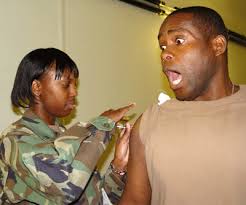
Here is a link to flu shot clinics for our county. It also includes a list of frequently asked questions such as who should get them and how much they cost.
Tuesday, September 1, 2009
Where do I get a flu shot?
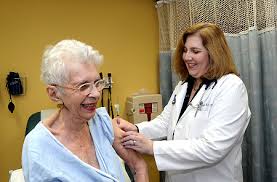 Regular seasonal flu shots are available, and I have not heard of any supply problems or shortages.
Safeway stores are already giving them.
The Public Health Department also has a Flu Hotline that you can call to find other locations for flu shots. The number is 621-6188.
Actually, the best time to get a flu shot is between Hallowe'en and Thanksgiving. This results in your immune system response to flu to be at its highest at the time we normally start to see flu which is December through February.
Wednesday, August 26, 2009
Perspective on Health Care
 This link is to a well written op-ed from the Washington Post and is worth a read. It's fairly brief, to the point and quickly summarizes the similarities and differences in structure, cost and quality of health care in various industrialized nations compared to the U.S.
It certainly reflects the data on the subject, and also my experience of health care in other countries as experience by me, my family or as related by my patients.
Current H1N1 flu vaccine recommendations by the CDC
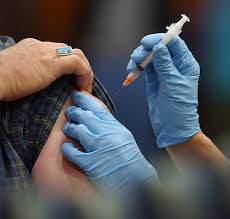 I understand through an email update from the California Medical Association, that vaccine for the novel H1N1 flu ("swine flu") is to be available along with the standard seasonal Autumn flu shots.
Realize that the H1H1 vaccine is separate from this, and is likely to require two shots in series.
The word is that access and supply are not going to be a problem, but in the event that it is, the CDC is recommending that certain groups get first access. Mind you, other sources such as WebMD had news coverage less than a week ago of production delays. It is important to remember that researching, developing and producing vaccines and other biologicals is extremely difficult. The flu vaccines are matured on chicken embryos for gosh sakes!
At any rate, the current recommendations for novel H1N1 flu vaccination in the event of inadequate supply is as follows:
First:
- Pregnant women
- Children 6 months to 4 years old
- Children 5 to 18 years old with chronic medical conditions
- health care workers with direct patient contact
- people living with or caring for children under 6 months old
- 19-24 year olds
- 25-64 year olds with chronic illnesses
- 25-64 year olds without chronic illnesses
- all persons 65 and older
Remember, this is different than the usual annual flu shots. Those are available and plentiful and should be received between Hallowe'en and Thanksgiving for best effect.
Tuesday, August 18, 2009
Novel H1N1 Flu- Update
The novel H1N1 influenza ("swine flu") is still being seen, including the unfortunate death of a local 52 year-old woman who apparently had chronic medical conditions as well.
Folks who are at higher risk for severe infection are those with chronic conditions (such as chronic lung disease) and also morbid obesity with a Body Mass Index over 35. The reason for this latter is not clear. Body Mass Index is calculated as follows: Weight/Height x Height and then multiply by 703.
Unfortunately, swab tests for detecting flu are not very accurate, and may detect flu only 50% of the time!
Otherwise, the H1N1 flu is similar to usual winter-time flu insofar as:
Folks who are at higher risk for severe infection are those with chronic conditions (such as chronic lung disease) and also morbid obesity with a Body Mass Index over 35. The reason for this latter is not clear. Body Mass Index is calculated as follows: Weight/Height x Height and then multiply by 703.
Unfortunately, swab tests for detecting flu are not very accurate, and may detect flu only 50% of the time!
Otherwise, the H1N1 flu is similar to usual winter-time flu insofar as:
- Symptoms are different than a common cold, since body aching and sense of weakness and illness is more severe.
- Medications for treating this flu are the same, and should be started within the first 2-3 days to be effective.
- You should cover your mouth when you cough, or wear a mask.
- Wash your hands frequently.
- You may return to work or school 24 hours after the fever has gone.
Thursday, August 13, 2009
To Grizzly Flats
The death of two neighbors and friends in a single day is a deep loss and sorrow. Patient privacy forbids me to name them, but we know who we're talking about here.
I've known and doctored both fellows for years, and their deaths are painful to me as the loss of two patients whom I've known, liked and respected for a long time.
For your community, I'm sure this sadness runs very deep. I have always, and will continue to be truly impressed by the genuine sense of mutual support and real neighborliness in your community.
With love and respect,
Mark Tong, MD
I've known and doctored both fellows for years, and their deaths are painful to me as the loss of two patients whom I've known, liked and respected for a long time.
For your community, I'm sure this sadness runs very deep. I have always, and will continue to be truly impressed by the genuine sense of mutual support and real neighborliness in your community.
With love and respect,
Mark Tong, MD
Tuesday, August 4, 2009
How your pharmacy works
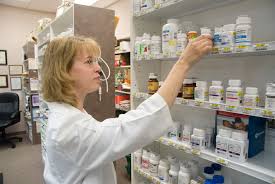
Much of what happens when you have a prescription occurs behind the scenes.
When you bring in a prescription, or if we call or fax it for you, the medication is labeled, placed in a secure bottle and checked against other medicines you obtain through that pharmacy to be sure that it is safe with your other medicines. The pharmacy also provides verbal and written instructions and precautions about the medicine.
When you need a refill, they provide this by phone and in many cases on-line through a dedicated website.
Even when the bottle says that there are no further refills, a call to the pharmacy will take care of this.
What happens is that they will fax me a request to okay any refills. We respond by faxing them back within 4 hours or less of receiving the request.
Mind you, we may also contact you if we notice that you are overdue for an annual physical or a follow-up appointment for a chronic medical condition. We may also wish to see you first if you are requesting a refill on a medicine that was prescribed a long time ago (such as a pain pill for a condition that went away a few years ago).
Because of the contracts that pharmacies have with commercial insurances (such as Blue Shield, Anthem, United, etc.) they can only fill prescriptions for 30 days at a time. I'm sure they'd be happy to be able to fill more at once, but if they do the insurance won't pay them for the medicines.
The reason for this is that the insurance companies have out-sourced discount contracts for medicines to Pharmacy Benefit Managers (PBM's) or "the mail order pharmacies" such as MedCo and Express Scrips. These companies are contracted with your insurance to contract with drug companies to provide discounted prices for large-volume buyers. In other words, your insurance saves money on medication costs by getting discount rates and requiring you to use them if you want to get more than a month's supply of medicines at a time.
You may use your insurances PBM by looking through the materials they send you every year, or by calling them at the toll-free number on your insurance card. They will provide you with any necessary paperwork. We can provide a 90 day prescription with up to a year's worth of refills if you ask. When this is sent in, they will mail 90 days at a time for up to a year to your address.
Do realize that you probably should not use the 90 day option for a new pill or a change in the dose, until we know it's working well and not causing you any problems.
Also, be aware that the military (CHAMPUS, TriCARE) operates differently. If you have no insurance, WalMart will fill many prescriptions for $4/month or $10/90 days. Just let us know which one you need when asking for a prescription.
Upcoming Vacation
 I will be away from the office catching a bit of beach time from Thursday through Monday!
Cindy will be here, so the office will be staffed to help you.
Wednesday, July 29, 2009
UFCW patients: yes we take your new insurance!
Effective 9/1/09, UFCW & Employers Benefit Trust (UEBT) and UFCW Northern California and Drug Employers Health and Welfare Trust Fund (Valley Drug Fund) will change from Anthem Blue Cross PPO to Blue Shield of California PPO.
We accept both of these insurances, so this change will not effect your health care at our office. All we ask is that you let us make a copy of your new card whenever we next see you.
We accept both of these insurances, so this change will not effect your health care at our office. All we ask is that you let us make a copy of your new card whenever we next see you.
Sunday, July 12, 2009
The Influence of Health Insurance Companies on Health Care Reform
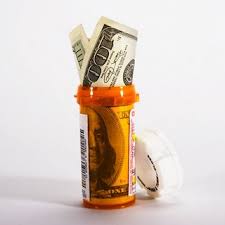
This is a link to a fascinating interview by Bill Moyer of Wendell Potter. Mr. Potter was employed as a Vice-President of Public Relations for Cigna, which is one of the largest health insurance companies in the US. Was, that is, until a bit of an eye-opener when he was back in Tennessee visiting family.
...we shouldn't fear government involvement in our health care system. That there is an appropriate role for government, and it's been proven in the countries that were in that movie.You know, we have more people who are uninsured in this country than the entire population of Canada. And that if you include the people who are underinsured, more people than in the United Kingdom. We have huge numbers of people who are also just a lay-off away from joining the ranks of the uninsured, or being purged by their insurance company, and winding up there.
The link is to a video, and also to a viewable and printable full transcript.BILL MOYERS: You told Congress that the industry has hijacked our health care system and turned it into a giant ATM for Wall Street. You said, "I saw how they confuse their customers and dump the sick, all so they can satisfy their Wall Street investors." How do they satisfy their Wall Street investors?
WENDELL POTTER: Well, there's a measure of profitability that investors look to, and it's called a medical loss ratio. And it's unique to the health insurance industry. And by medical loss ratio, I mean that it's a measure that tells investors or anyone else how much of a premium dollar is used by the insurance company to actually pay medical claims. And that has been shrinking, over the years, since the industry's been dominated by, or become dominated by for-profit insurance companies. Back in the early '90s, or back during the time that the Clinton plan was being debated, 95 cents out of every dollar was sent, you know, on average was used by the insurance companies to pay claims. Last year, it was down to just slightly above 80 percent.
So, investors want that to keep shrinking. And if they see that an insurance company has not done what they think meets their expectations with the medical loss ratio, they'll punish them. Investors will start leaving in droves.
I've seen a company stock price fall 20 percent in a single day, when it did not meet Wall Street's expectations with this medical loss ratio.
Check it out, if you are interested to understand how commercial insurance companies influence the discussion and the political process around the reform of our health care system.
Wednesday, July 8, 2009
Tylenol, Vicodin and Percocet safety
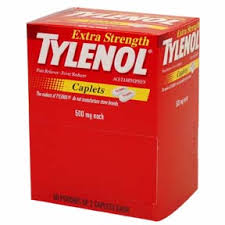 If you follow the news much, you will be noting that an advisory panel to the Food and Drug Administration (FDA) is expressing concerns about the safety of two commonly prescribed narcotic "pain-killers" Vicodin and Percocet, and also about the safe dosing levels for Tylenol (generically known as acetaminophen).
Just to clarify, the issue is not so much about the maximum safe doses of acetaminophen so much the fact that it's in a number of prescription and over-the-counter medications and that it may be easy for people to accidentally take too much as they may not realize how much they are actually taking.
Acetaminophen is in "non-aspirin pain relievers" over the counter, and in Tylenol as regular,
Extra-Strength and Arthritis. It is also in a large number of generic and Tylenol brand cough and cold formulas, allergy medicines and sleep aids.
In addition to this, it is a component of Vicodin and Percocet which are prescription medicines for pain.
You can start to see where it might be easier than you suppose to get more acetaminophen into you than you thought. This Q&A rather sums it up:
People think that if it’s a safe drug and I have this pain, it works better if I take more,” said Cesar Alaniz, a clinical associate professor at the University of Michigan College of Pharmacy.
Tuesday, July 7, 2009
How Do Drugs Get Tested?
The recent news about over-the-counter (OTC) Zicam causing a loss of sense of smell in over 300 people raises a few eyebrows. Frankly, Bextra being withdrawn in 2005 for being linked to causing an increase in heart attack risk raised quite a few eyebrows, too.
It's important to make a distinction between pharmaceuticals and supplements.
Pharmaceuticals are regulated and approved by the Food and Drug Administration (FDA) and must be proved to be safe as well as effective in treating the condition for which approval is being sought.
Supplements, herbs and vitamins are marketed as nutritional or dietary supplements and therefore are not required to meet any such standards. Let the buyer beware!
By the time a pharmaceutical has received FDA approval to be sold, it has been researched and extensively tested in labs and then in humans for both safety and effectiveness. The testing in humans usually involves several thousands of folks, half of whom receive the tested drug and the other half a placebo.
This is done in such a way that the doctor giving the drug doesn't know whether the person will receive an active drug or a placebo. This is called randomized, double-blind placebo/control study, and is intended to keep people from reporting or not reporting side-effects because they know beforehand whether they got drug or placebo. Also, it is done this way so the doctor cannot reveal whether they are getting drug or placebo, either.
Granted, this assumes that the drug manufacturer is conducting the research in accordance with standards, and isn't "massaging the data". It also assumes that the directorship of the FDA is aggressively pursuing its mandate on behalf of the public.
In the case of Bextra, the drug company reported 11 months of heart attack data as a full year, thereby under-reporting the incidence of heart attacks related to the drug to the FDA.
Also note that the burden of proof of effectiveness and safety is on the company, and not the FDA. This is as it should be from the point of view that the costs of such proof should be on the company which stands to profit from FDA approval, and should not be upon the consumers and taxpayers.
Also, it is important to realize that if a drug as a rare side-effect and perhaps only occurs in one out of 10,000 or 50,000 people who take it, this is not going to become evident until several million people have taken it. This is neither a failure of the drug company, nor the FDA. This is simply a fact of life, which is why there are processes for reporting potential rare but serious side-effects with medicines. An example of this is the current investigation of psychiatric side-effects with the new smoking cessation drug Chantix.
Bottom Line:
Supplements and herbs differ from pharmaceutical drugs significantly in that they are not required to be proven to be safe or effective, nor to be tested for interactions with medicines or foods, nor for truth in labelling.
This does not mean that they do not work or should never be taken, but it does mean that a reasonable degree of skepticism in the literal sense should be exercised.
Sunday, July 5, 2009
A trial period of changes in hospital coverage: and now for something completely different!
 Short story:
Starting Monday July 13th, for a trial period through the end of October, my call group will have patients admitted and cared for by the hospital's hospital-based doctors for 3 weeks on and 3 weeks off. We will care for our patients for 3 weeks off and 3 weeks on, alternating with the hospital-based docs.
At the end of this trial period, we'll see how it's been working out for everyone, including our patients to see if we all want to continue on in this 3 weeks on/3weeks off cycle.
Long story:
Physicians used to be on-call for the needs of their patients 24/7/365. Naturally, that gets old pretty quickly since you can never be away from a phone our out of the area.
A few decades ago, a common practice developed where different doctors would agree to share coverage on evenings, weekends and holidays. When you are on-call you're on for the group, but when you're off you're all the way off (as in you can go fishing or skiing, leave town, catch a movie with your kids...).
In the past 5 or so years, a nationwide trend which Marshall adopted is one in which family doctors only see patients in the office, and the hospital hires doctors who only see patients in the hospital (such doctors are referred to as hospitalists). Supposedly, the patients get better care as they are seen by doctors who only ever treat hospitalizably ill people. Also, supposedly this is more profitable for both the family docs and the hospital.
So far, no one including Marshall can demonstrate a difference in hospitalist versus family doctor care in terms of the complexity of the patients, how well they do and how long they have to stay in the hospital.
Unfortunately, one outcome of this is that there are only 7 primary care docs in Western El Dorado County who still see patients in the office and also in the ER and in the hospital. Marshall's own doctors backed out of the hospital about 5 years ago and can't come back.
I share call with Drs. Keith Boston, Leanne Camisa and Dave Ramos. This means if you have to be in the hospital after hours, one of us will be admitting you and I will see you first thing in the morning (or on Monday AM, if it's a weekend).
Thing is, Camisa and Ramos are married and have two young children. As you can imagine, they are finding it increasingly difficult for one or the other of them to be on-call literally half of their lives.
Bottom Line:
For my call group to continue to function, we needed to come up with some form of relief.
We still feel the best care you are going to get if you get really sick is going to come from a doctor who already knows you well.
We think the hospital docs are excellent docs, but would prefer to take care of our own patients because it's important to us.
However, the times are changing around us and there aren't many of us left doing the full range of practice.
So, we want to try out a system where we're each on-call every fourth night and weekend for 3 weeks in a row, and then 3 weeks off.
During this 3-week off period, the hospital docs will be informed as to your medical history, surgeries and your medications.
Please let me know how you feel about this, and please let me know if you are in the hospital but feel that you would rather that I was seeing you there.
Again, this is a trial period from mid-July for about 3 months. At the end of it, we'll be seeing how it's working out for everyone involved especially our patients.
Saturday, July 4, 2009
Happy July 4th!
 Have a happy holiday celebrating our nation's independence with your friends and family.
In case it interests you, this link comments on a plain English contemporary reading of the Declaration of Independence. This link is a how-to on photographing fireworks displays.
Remember, that long stick coming out of the rocket is for staking it into the ground; it's not a handle... :-)
Wednesday, June 10, 2009
Samsung Jitterbug- nice idea for older folks who live alone
A patient who is in her 80's and lives alone, while her son lives nearby in town showed me this last week. (Sorry, tried to upload a photo of it- drat this Blogger!)
Basically, it's a cell phone that you can get through the usual cell phone vendors that is well designed and intended for older folks (especially ones living alone).
It's large and soft enough to be held easily, but is only slightly larger than most cell phones. It opens like a clamshell phone, so the keyboard is protected from damage or accidental activation.
The keys and display are large enough to read and to use easily, even by folks with less than 20/20 vision or "arthur-itis".
A special model of this has three keys colored green, yellow and red. One calls Operator, one calls Help (such as a friend, relative or neighbor) and one calls 911.
My patient liked this over the usual LifeLine pendant ("Help! I've fallen and I can't get up!"), because it works outside the home, and she can also call her son instead of every distress call resulting in an EMT/fire department response.
Basically, it's a cell phone that you can get through the usual cell phone vendors that is well designed and intended for older folks (especially ones living alone).
It's large and soft enough to be held easily, but is only slightly larger than most cell phones. It opens like a clamshell phone, so the keyboard is protected from damage or accidental activation.
The keys and display are large enough to read and to use easily, even by folks with less than 20/20 vision or "arthur-itis".
A special model of this has three keys colored green, yellow and red. One calls Operator, one calls Help (such as a friend, relative or neighbor) and one calls 911.
My patient liked this over the usual LifeLine pendant ("Help! I've fallen and I can't get up!"), because it works outside the home, and she can also call her son instead of every distress call resulting in an EMT/fire department response.
Monday, June 1, 2009
Working With Your Hands
 This is a really nicely written article by a guy with a Ph.D. in political philosophy who is very happily and fully self-employed repairing motorcycles.
The trades suffer from low prestige, and I believe this is based on a simple mistake. Because the work is dirty, many people assume it is also stupid. This is not my experience. I have a small business as a motorcycle mechanic in Richmond, Va., which I started in 2002. I work on Japanese and European motorcycles, mostly older bikes with some “vintage” cachet that makes people willing to spend money on them. I have found the satisfactions of the work to be very much bound up with the intellectual challenges it presents. And yet my decision to go into this line of work is a choice that seems to perplex many people.I was very impressed by the kind of thinking that goes into how this guy solves problems.
In fixing motorcycles you come up with several imagined trains of cause and effect for manifest symptoms, and you judge their likelihood before tearing anything down. This imagining relies on a mental library that you develop. An internal combustion engine can work in any number of ways, and different manufacturers have tried different approaches. Each has its own proclivities for failure. You also develop a library of sounds and smells and feels. For example, the backfire of a too-lean fuel mixture is subtly different from an ignition backfire.Hmmm. Sounds like a day in my life...
Tuesday, May 5, 2009
Swine Flu- Update

Yes, there has been a confirmed case of H1N1 ("swine") flu in a student at Camino School. The school has decided to close for a week to diminish the chances for spread within our community. The virus is known to be contagious for 7 days after the onset of illness.
The good news is that the virus shows none of the markers for severe disease, and is not resulting in illness any more severe than a usual seasonal flu!
Wednesday, April 29, 2009
Swine Flu- An Historical Perspective

Most folks have heard that the Spanish Flu pandemic at the close of World War I killed millions of people, and was a shocking illness that left memories of it for generations afterwards. This is certainly true.
However, in the context of the current early stages of this influenza outbreak, it is useful to look back at the Big One in a more statistical light.
As many as 2.5% of people who got the flu died.
This does not mean that 2.5% of the world's people died, it means that 2.5% of those who got the flu died.
In fact, only 28% of the world's entire population got the flu at all. 97.5% of them survived.
In other words, in the world's worst flu pandemic in history to date your odds of not getting the flu at all were 7 out of 10, and if you did get it your chances of survival were better than 9 to 1.
And this was before advanced emergency medical care, advanced hospital care and before antiviral and antibiotic medicines.
Subscribe to:
Posts (Atom)